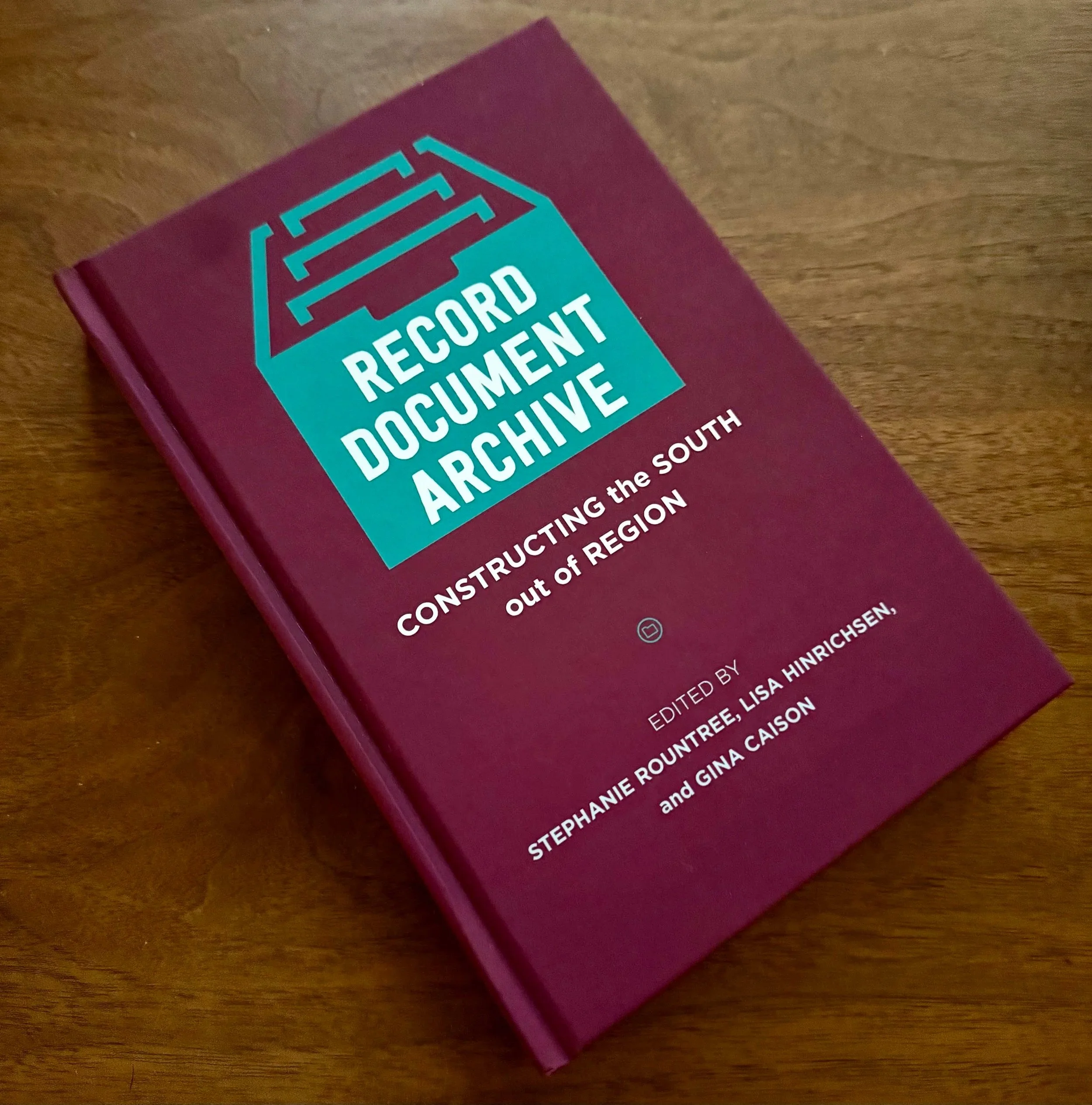
Record, Document, Archive
Record, Document, Archive illuminates how the U.S. South is made knowable through the acts, objects, and systems that produce records, documents, and archives. Rather than treating “the South” as a fixed geography or predetermined object of study, this innovative, forward-thinking collection reframes region as an ontological and epistemological project shaped by—and resistant to—Eurocentric regimes of documentality.
Bringing together activists, archivists, and scholars across disciplines, the essays in Record, Document, Archive trace the extent to which documentality has governed life and death in the U.S. South, from Indigenous Removal, enslavement, and Jim Crow to contemporary regimes of immigration enforcement, border policing, and the legal erasure of queer and undocumented lives. “Record” emphasizes embodied, affective, and more-than-human acts of marking experience. “Document” interrogates the pedagogical, legal, and evidentiary force of documentation, highlighting counter-hegemonic methods that unsettle dominant southern narratives. “Archive” addresses curation, access, and governance, advancing liberatory memory work that confronts archival violence and privilege while imagining new possibilities for justice-oriented futures.
By attending to the anticipatory acts that precede narrative and law, Record, Document, Archive opens pathways toward “southern elsewheres”—modes of knowing, remembering, and belonging that resist rigid epistemologies and orient scholarship toward liberation.
Praise
From the precolonial past to the anticolonial present, from lesbian herstories to environmental futures, this volume challenges us to rethink both the objects of study and the acts of studying them. And in that regard, this book might be better understood as a kind of decolonial treasure map, if such a thing makes sense—one that does not lead us to the discovery of some single truth about what we call ‘the South,’ but that helps us reconsider the pursuit and production of knowledge itself and begin charting a path toward an elsewhere that is nothing less than the whole world. Everybody working in U.S. southern studies will read this book. Everybody else needs to read this book.” ~Michael P. Bibler, author of Cotton’s Queer Relations: Same-Sex Intimacy and the Literature of the Southern Plantation, 1936–1968